
The Cooke Extension: Augmenting Ahnentafel numbers to index your entire family
The Ahnentafel numbering system gives every direct ancestor a unique number before you start researching. Learn the system, the pen-and-pencil verification method, and the Cooke Extension approach for organizing siblings, spouses, and cousins too.
Alden Cooke
2/21/20269 min read
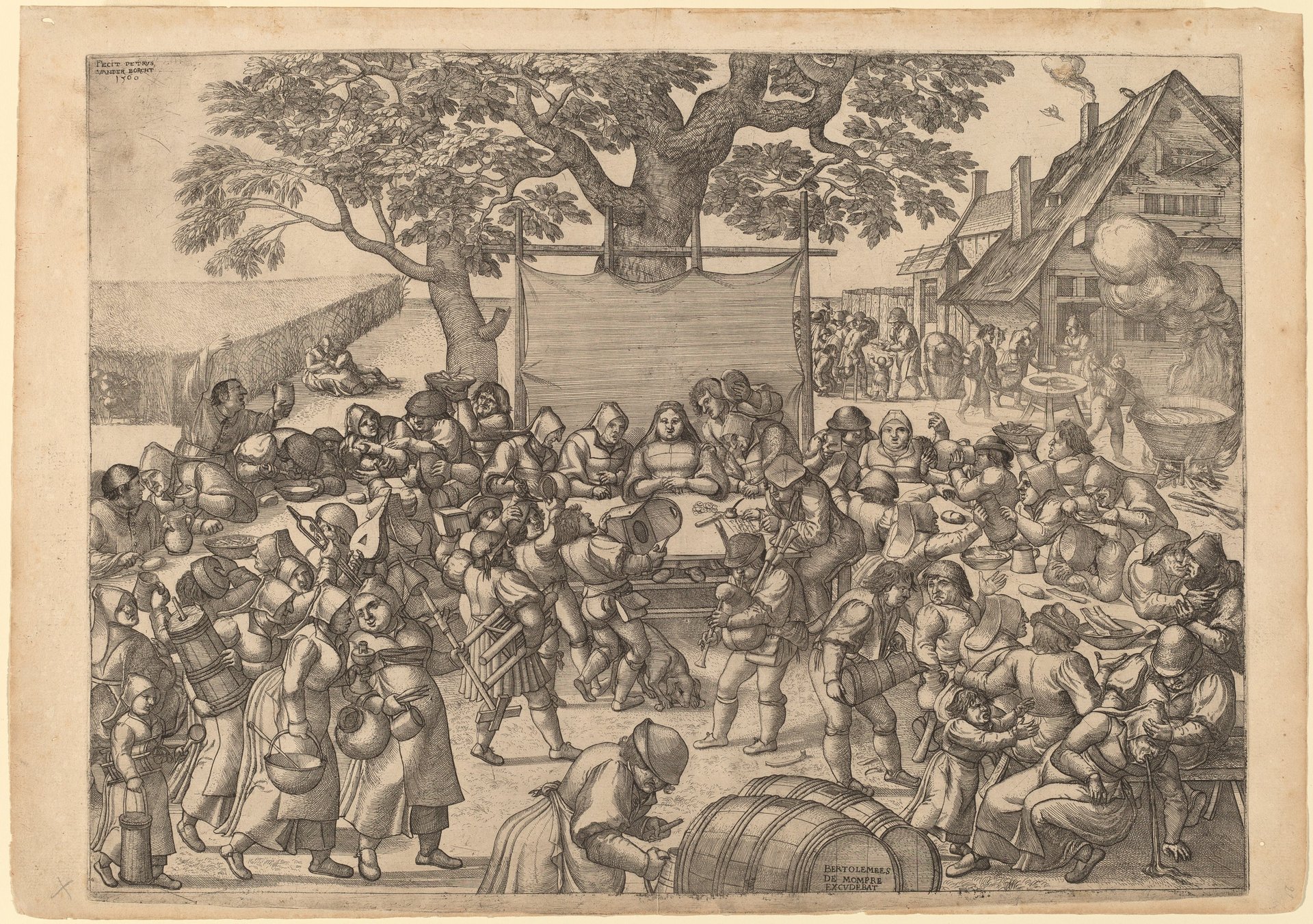
"The Large Rustic Wedding Feast"
Peter van der Borcht, 1560. Public domain.
Setting a formal place for siblings, cousins, spouses, and stepfamilies in your ancestry research will make your family tree more joyful.
The Fourteen-Tab Problem
Here is something that happens to almost every new family researcher. They find a promising census record, follow a hint to a marriage certificate, pull up a ship manifest, and three hours later they are staring at a browser with fourteen tabs open and no idea which of the four men named William Crawford they were originally looking for.
The research did not go wrong. The organization did. And the fix is simpler than you might expect: you need an index before you need anything else.
Not a spreadsheet. Not a software subscription. A notebook, a pen, and a pencil. The pen and pencil both matter, and I will explain why.
The tool that makes this index work is one of genealogy's oldest and most useful inventions: the Ahnentafel numbering system. But using it alone isn't enough. You need an extension.
The Ahnentafel Numbering System
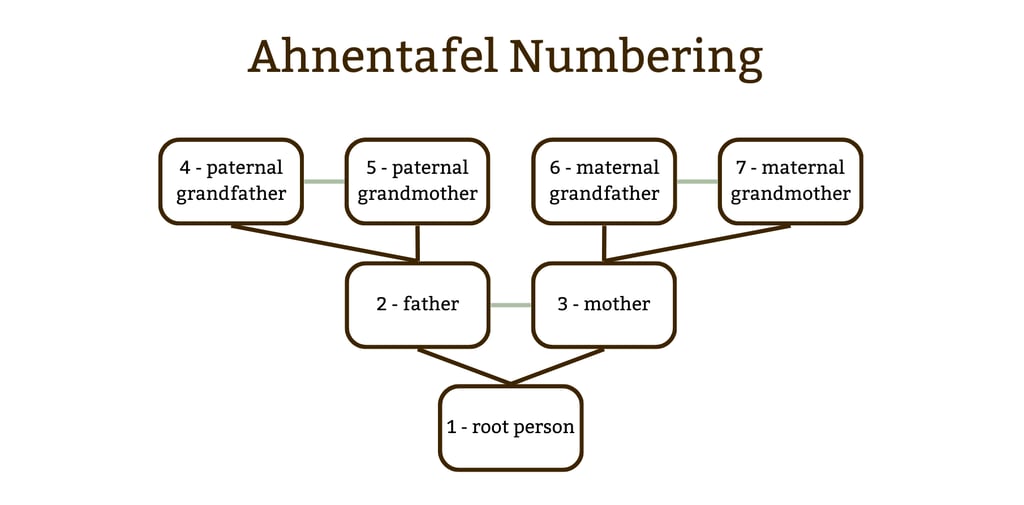
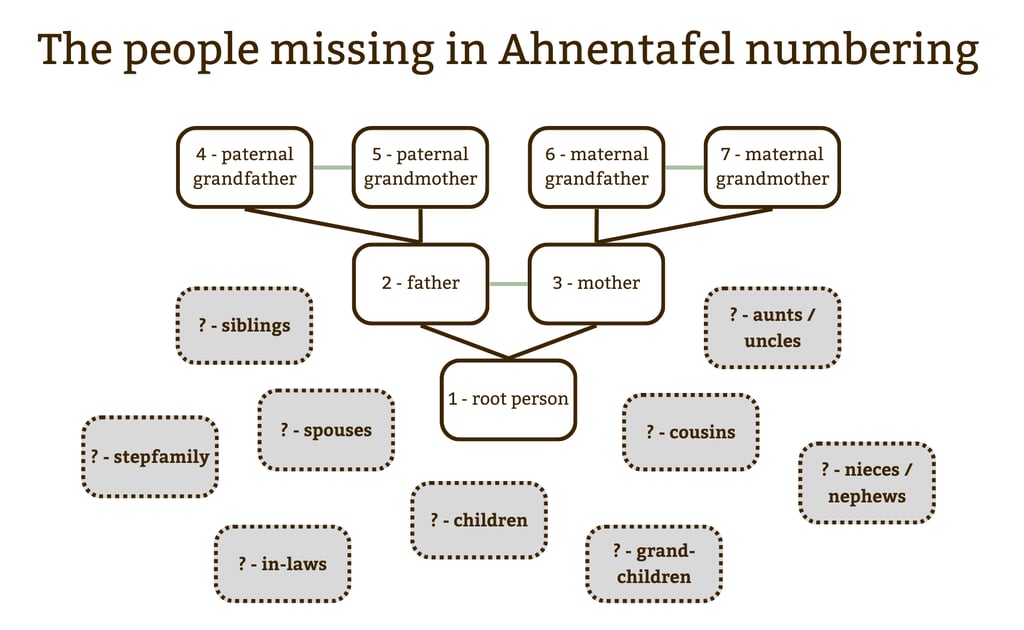
Ahnentafel is German. "Ahnen" means ancestors, "tafel" means table. Ancestor table. The system has been in use in various forms since at least the 16th century, and the modern standardized form is used by genealogists worldwide.
The core idea is that every person in your direct ancestral line gets a unique number, and that number encodes exactly where they sit in your tree.
You are number 1. Your father is number 2. Your mother is number 3. Your paternal grandfather is number 4, your paternal grandmother is number 5, your maternal grandfather is number 6, your maternal grandmother is number 7. The pattern holds all the way back: any person's father is always double their number, and any person's mother is always double their number plus one.
If I tell you my great-great-grandmother on my father's mother's side is number 13, you can work out exactly where she sits without seeing any other document. The number carries the information.
One side effect of the math: all men in the direct line have even numbers and all women have odd numbers, with the single exception of you at number 1.
The Notebook Rule: Pen for Proof, Pencil for Possibility
Get a dedicated notebook for this. Not a section in a bigger notebook. A whole notebook, just for your family index. On the first page, start listing your ancestors with their Ahnentafel numbers, full names (maiden names included for women), and approximate birth years.
Then apply this rule without exception: anyone you have fully verified goes in pen. Anyone you believe is correct but have not yet confirmed with documentation goes in pencil.
What counts as fully verified? For this purpose: you have documentary evidence of their birth or baptism, their death or burial, their relationship to their parents, and their relationship to their children. All four, from primary sources where those sources exist.
If you are not familiar with the Genealogical Proof Standard (GPS), it is the framework professional genealogists use to define what "proven" actually means in this work. The short version is that a fact is not proven because you found it in someone else's online tree. It is proven because you traced it back to original records and resolved any contradictions.
The pencil entries are not failures. They are your research agenda. Every name in pencil is a person you are still working to confirm. When the documentation comes in and the record matches, you ink them in.
This does something psychological as much as practical. It forces you to be honest with yourself about what you actually know versus what you have assumed. Online family trees are full of connections copied from other unverified trees, sometimes going back a dozen generations of guesswork. Your notebook does not inherit other people's guesses.
The Problem the Ahnentafel Does Not Solve
The Ahnentafel system is clean and logical, but it only numbers people in your direct ancestral line. That is its design. It is also its limitation.
Your great-grandmother gets a number. Her sister, who might have raised your great-grandmother's children after her early death, who appears in the same census records and the same letters and the same land disputes, does not get a number. She is invisible to the standard system, even though she may be central to understanding your family.
The same problem applies to your spouse, who is not your biological ancestor but central to your life, to cousins who emigrated at the same time and can help you trace an immigrant line, to siblings who stayed in the old country when others left. It lacks a home for in-laws who are vital to your children's story and stepchildren who may have been close to your ancestors as their biological children. These people show up constantly in research, and without a system to keep track of their stories and value in your ancestors' story can be lost. Or even worse, documented incorrectly.
The Cooke Extension: Numbering the Rest of the Family
Genealogists have proposed workarounds for the collateral-relative problem before. Some combine Ahnentafel numbers with decimal notation for descendants. Genealogist William Dollarhide suggested adding an asterisk (or 1, 2, etc.) to flag a spouse. Family Tree Magazine has noted that some researchers use a combined Ahnentafel-plus-d'Aboville approach, assigning a sibling like Prince Harry the number 2.2. None of those systems does everything I need, so I developed my own extension of the standard Ahnentafel. I call it the Cooke Extension.
What follows is the complete logic. It builds directly on the standard numbering, so if you already use Ahnentafel, you can add this without changing anything you have already done. Here are the rules:
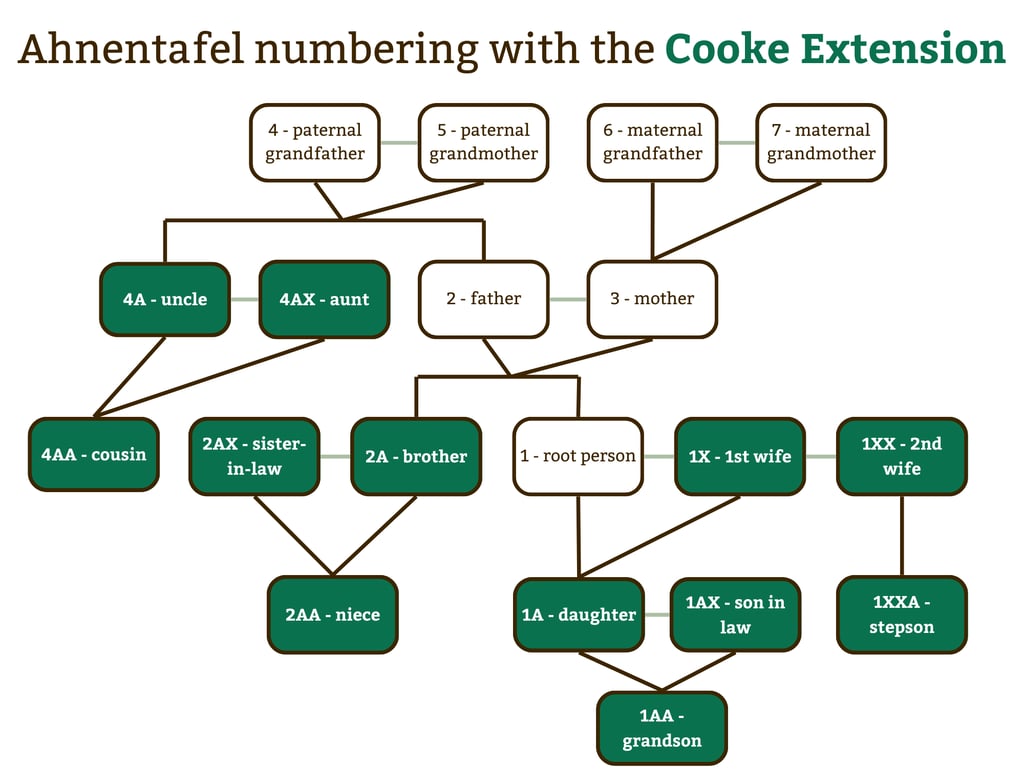
The root person and direct ancestors have whole numbers.
Everyone else inherits the nearest numbered ancestor's number, extended with letters.
Letters are assigned under their father's number, except for unrelated spouses who take the number of their spouse, plus the letter "X." Additional spouses get an additional "X" based on the order of their marriage, with the first spouse having one "X," the second spouse being "XX," etc.
Letters are assigned in birth order, starting with A for the father's firstborn child. The second-born child of the father is B, and so on through the alphabet.
People in the direct line of ancestry are not assigned letters because they already have their own number in the Ahnentafel system. These people are "skipped in the birth order lettering.
Take an imaginary family. Leon Smith is our root person, so Leon is number 1. Leon's father Joseph is number 2. Leon's mother Elise is number 3.
Joseph and Elise have three children: Grace (the eldest), Leon, and Helen (the youngest). In the standard system, Grace and Helen have no numbers. In this extended system, we assign letters based on birth order among Joseph's children.
Grace, the eldest, is 2A. Leon, as the direct ancestor, occupies the B position in birth order, but we skip that letter in the index. The gap is intentional. When you see a missing letter in a sequence, you know the numbered ancestor sits there. Helen, the third child, is 2C.
When Helen marries, her first husband gets her number with an X appended: 2CX. The X means spouse of this person, not a blood relative of the root person. If Helen divorces and remarries, her second husband is 2CXX. A third marriage would produce 2CXXX. The number of X's tells you which marriage.
If Grace (2A) has children, they extend her letter string. Her first child is 2AA, her second is 2AB, her third is 2AC. Grace's grandchildren extend further: 2AA's first child is 2AAA, the second is 2AAB, and so on. The letters just keep going.
When those descendants marry, the same X convention applies. If 2AA marries, their first spouse is 2AAX. A second spouse would be 2AAXX.
If a spouse brings children from a previous relationship into the family, those children are not biologically related to the root person, but they are real people who appear in records and in the family story. They get the spouse's number with letters appended. John (2CX) brought two children from a prior relationship: his eldest is 2CXA, his second is 2CXB.
That is the complete system. Every person connected to your family, however they are connected, has a unique address in your index. You can find them, cite them in your notes, and track them across documents. You can also clearly see people who are not directly related, as they have an "X" in their number, if you want to research only the family, not their spouses' families.
This may seem confusing at first! But once you get the hang of it, it allows you to organize everyone related to the root person backwards to their ancestors, sideways to their siblings and cousins, and down to their descendants with the same level of precision.
Why a Physical Notebook and Not Software
Genealogy software is genuinely useful for many things. An index is not one of them.
The problem with software is that it makes everything look equally certain. A name in a database field looks exactly the same whether it came from a birth certificate or from a stranger's unverified online tree. The pen-and-pencil system in a physical notebook makes uncertainty visible in a way that no font color or status field ever quite replicates.
There is also something about the physical act of writing a name in pen, after you have done the work to verify it, that registers differently than clicking a confirm button. This is not sentimentality. It is a useful friction. If you have to find the pen and deliberately ink a name, you have thought about it one more time before committing.
Start the notebook before you open a single website.
Frequently asked questions
What is the Ahnentafel numbering system?
Ahnentafel is a German word meaning "ancestor table." It is a genealogical numbering system that assigns every person in your direct ancestral line a unique number. You are number 1. Your father is number 2, your mother is number 3. From there, any person's father is always double their number, and any person's mother is always double their number plus one. The number alone tells you exactly how a person is related to the root person, without any additional chart or diagram.
What is the Cooke Extension?
The Cooke Extension is a system for extending standard Ahnentafel numbering to include siblings, spouses, descendants of collateral relatives, and step-children. Developed by genealogy author Alden Cooke, it assigns letters to non-ancestor family members appended to the nearest ancestor's number (2A, 2C), extends those letters down through generations (2AA, 2AAA), and uses stacked X's to indicate spouses and marriage order (2CX for a first spouse, 2CXX for a second). The system leaves a deliberate gap in the letter sequence wherever a direct ancestor sits, making the direct line immediately visible in any index.
How do I number siblings in a family tree?
The standard Ahnentafel system only numbers direct ancestors, so siblings have no built-in place in it. One solution is the Cooke Extension, which assigns letters to non-ancestor family members based on birth order under their parent's number. If your father is number 2, his eldest child (your aunt) is 2A. You as the direct ancestor occupy but skip the 2B slot, and a younger sibling becomes 2C. The gap in the letter sequence marks where the direct ancestor sits.
How do I track spouses who are not my direct ancestors?
In the Cooke Extension, spouses of non-ancestor relatives get the relative's index code with an X appended. A first spouse is X, a second is XX, a third is XXX. If your great-uncle is 2C and he married twice, his first wife is 2CX and his second is 2CXX. Spouses of direct ancestors already have their own Ahnentafel numbers and do not need an X designation.
What is the Genealogical Proof Standard?
The Genealogical Proof Standard (GPS) is the framework professional genealogists use to determine whether a conclusion about a family relationship is actually proven. It requires a reasonably exhaustive search of available sources, complete and accurate citations, analysis of each source for its quality and origin, resolution of any conflicting evidence, and a written conclusion that explains the reasoning. Finding a name in someone else's online tree does not meet the GPS. A birth certificate, a census record, and a death certificate that all agree, with conflicts resolved and sources cited, begins to meet it.
Should I use genealogy software or a notebook to track my ancestors?
Both have their place, but a physical notebook does something software does not: it forces you to distinguish between what you have proven and what you have assumed. Writing confirmed facts in pen and unconfirmed ones in pencil creates a visible record of your research state that no software interface fully replicates. The notebook is your index and research agenda. Software is where you build the fuller record once the facts are verified.