
The Bravery of Your Revolutionary War Ancestors
You might be descended from someone who changed the world. It's time to find out.
Alden Coooke
2/28/20265 min read
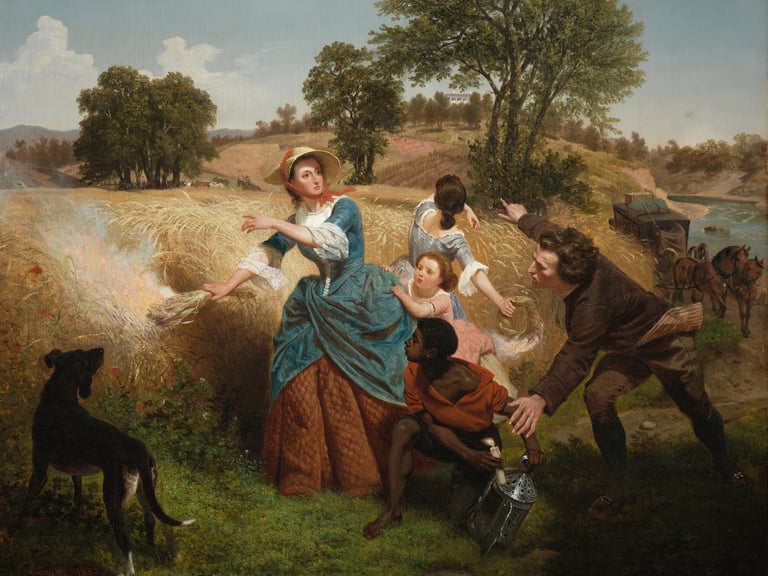
"Mrs. Schuyler Burning Her Wheat Fields on the Approach of the British,"
by Emanuel Leutze, 1852. Public domain.
Whether or not this exact event occurred, the question it poses is real: what would you have done?
It Wasn't What You Think
Here's the thing they don't teach you in school: most colonists didn't wake up on April 19, 1775 ready to fight. They woke up confused, frightened, and deeply divided.
By most historical accounts, the colonists were divided over whether to fight for independence from the King. Some were patriots. According to the Library of Congress, approximately 20-30 percent were Loyalists who believed breaking from Britain was madness: economic suicide, political folly, an act of treason against their king. And there was a middle group that wanted nothing more than to keep their heads down, tend their farms, and wait to see who won.
That middle group is important. Because those are the people who eventually had to choose.
It wasn't until January 1776, when a recent immigrant named Thomas Paine published a 47-page pamphlet called Common Sense, that something shifted. Paine didn't write like a philosopher or a politician. He wrote like a friend who was furious and couldn't stop talking. He made the case for independence in plain language that anyone could read aloud at a tavern table, and people did exactly that. According to the latest research on printing technologies and literacy rates during the period, as reported in the Journal of the American Revolution, Common Sense sold tens of thousands of copies across the colonies. It didn't create the revolution. But it gave people the words for what they were already feeling, and it pushed the undecided toward a line they couldn't uncross.
Your ancestor may have read it. Or had it read to them. And then they had to decide.
"Give Me Liberty, or Give Me Death"
Patrick Henry almost certainly didn't want it to come to this.
That's the part of the story that gets lost. Henry was a Virginia lawyer and legislator, known as passionate and brilliant, and by the early 1770s, increasingly convinced that the relationship between the colonies and the Crown was broken beyond repair. But conviction and action are two different things, and Henry understood better than most what choosing action would cost.
On March 23, 1775, more than a year before the Declaration of Independence, Henry stood before the Second Virginia Convention in Richmond and delivered what became one of the most famous speeches in American history, as documented by future US Attorney General William Wirt. The room was full of men Henry knew. Men who were not sure. Men who were afraid of exactly what Henry was about to say out loud.
He said it anyway.
"Is life so dear, or peace so sweet, as to be purchased at the price of chains and slavery? Forbid it, Almighty God! I know not what course others may take; but as for me, give me liberty, or give me death!"
What makes that speech worth sitting with, really sitting with, isn't the famous last line. It's the phrase before it: I know not what course others may take. He wasn't speaking to people who agreed with him. He was speaking to a room full of people who were still deciding. He was asking them to be brave in a way that costs something.
Now imagine that speech wasn't delivered by a famous man in a famous room. Imagine it was delivered at a kitchen table in a farmhouse in western Massachusetts, or coastal Georgia, or the Pennsylvania backcountry, by your great-great-great-great-grandfather. To his family. Who had to live with whatever he decided.
The Choices Nobody Talks About
Not every patriot picked up a musket. That's something the history books underserve.
The Revolution ran on an entire invisible economy of ordinary courage. There were young families who managed farms alone for years while the adult men were gone, keeping themselves fed and their land from being seized. There were free Black men who enlisted, and enslaved men who fought as well. There were women who carried intelligence through British checkpoints because no one suspected them. There were printers, tavern keepers, and merchants who kept supply lines alive at personal financial ruin.
And there were families who were split down the middle. Brother against brother. Choosing a side in 1776 wasn't as easy as writing a social media post. It was life-changing.
Your ancestor lived inside that. Whatever they chose, musket, messenger, silent supplier of food and shelter, they chose it knowing what it would cost. They chose it in a world where the outcome was genuinely unknown, and where being on the wrong side of the outcome meant ruin or worse.
They chose it anyway.
That choice is in you. Literally. You would not exist if they had chosen differently, or if a musket ball had found them on a different Tuesday, or if the fever that swept through the winter encampment had taken them instead of the man next to them. The United States exists today because of the choices our ancestors made.
Why This Matters for Your Family
Here's where genealogy earns its keep.
History taught from the outside is a series of events. History found through your own family tree is a series of decisions. And when you find a Revolutionary War ancestor, really find them, trace the records, read what their regiment did, understand what year and place and circumstance they were living in, you stop reading history and start inhabiting it.
You learn what town they were in, and then you learn what happened in that town in 1777. You learn who their neighbors were, and you start to wonder whose side the neighbors took. You learn that your ancestor signed a loyalty oath, or appeared on a muster roll, or petitioned for a pension as an old man describing a war he'd fought sixty years before in his own words, and suddenly the Revolution isn't something that happened. It's something your family did.
That's worth finding.
A Small Bonus, If You Want It
Once you find a Revolutionary War patriot ancestor and document the lineage connecting you to them, a world opens up that most people don't know exists.
The Daughters of the American Revolution (DAR) and the Sons of the American Revolution (SAR) are lineage societies; they're also some of the best-funded genealogical research organizations in the country, with archives, libraries, and scholarship resources that are genuinely useful regardless of whether membership interests you. The DAR's library in Washington, D.C. holds material you won't find anywhere else.
No matter whether you want to formally document your lineage to an American patriot, or whether you just want to know the story for yourself, researching your family and how they participated in American history is an honor to those who came before you, and a gift for your family today.
To your ancestors, you can say, I found you. I know what you did. I'm not going to forget.
Their efforts mattered. So do yours.
PS - if you need the tools to find your ancestor, including a guide, workbook, and research system, they are all available here: America 250