
What "Lexington Alarm" on a Gravestone Actually Means (And Why It Might Be in Your Family Tree)
If you've ever spotted "Lexington Alarm" carved on an old gravestone and wondered what it meant, this post is for you. Here's the story of April 19, 1775, Patriots' Day, and how to find out if your ancestor was there.
Alden Cooke
4/18/20269 min read
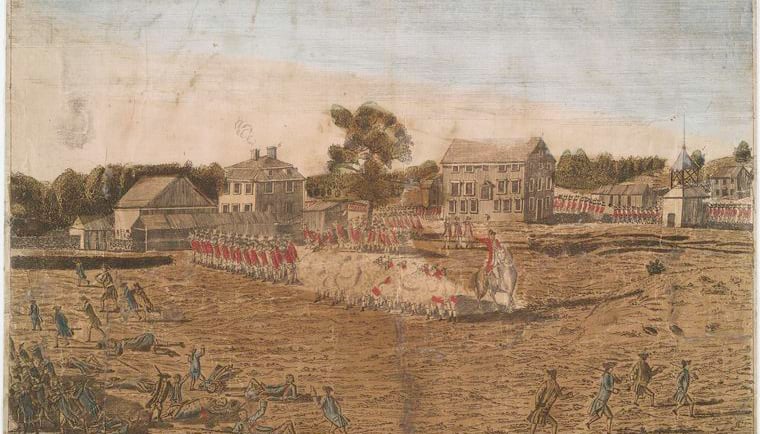
"Battle of Lexington, April 19th. 1775. Plate I"
by Amos Doolittle (engraver), Ralph Earl (artist), 1775. Public domain.
The men who fought at Lexington on April 19, 1775 were not the only ones called to the "alarm"
Table of Contents
The gravestone mystery
The night before: what was actually happening
The morning of April 19, 1775
The alarm spreads, and where your ancestor might come in
What happened the rest of that day
What is Patriots' Day, exactly?
How to find out if your ancestor answered the Alarm
What if you don't have a Revolutionary War ancestor?
The gravestone mystery
Imagine you're browsing old cemetery records, maybe on FindAGrave, maybe on a digitized index, maybe in person with a phone camera and muddy shoes. You find an ancestor from the 1700s, and the stone reads something like, "responded to the Lexington Alarm, 1775."
What does that mean? Was he at Lexington? Was it a battle? Was it just a name?
Here's what it means: your ancestor heard that the Revolutionary War had just started, and he got up, grabbed his musket, and marched toward it.
That inscription is three words telling you your ancestor was there at the beginning. Not just alive during the Revolution, but really there, responding, moving toward the sound of guns while the first battle of the war was still being fought.
And here's the part that will matter for your research: the Lexington Alarm reached men from Connecticut, Rhode Island, New Hampshire, and beyond. The men who answered it came from hundreds of miles away. So if your family has roots anywhere in New England, and a surprising number of American families do, even if they don't know it — there's a real chance someone in your tree is in these records.
The night before: what was actually happening
It's April 18, 1775. Boston is essentially an occupied city. British troops, aka "Regulars," or "Redcoats," have been there for years, and tensions with the colonists have been building for most of a decade. Both sides knew a confrontation was coming. The colonial militias have been quietly training since fall 1774, and Patriot leaders had already moved most of their weapons stockpiles to safer locations.
On the night of April 18, about 700 British Regulars received secret orders to march from Boston to Concord, 20 miles away, to seize whatever military stores remained there. The operation was supposed to be covert.
It wasn't.
Paul Revere and at least one other rider slipped out of Boston that night to warn the towns along the British route. Revere reached Lexington around midnight and alerted Patriot leaders Samuel Adams and John Hancock that the Regulars were on their way. He was captured before he could reach Concord, but the warning got there anyway.
In Lexington, Captain John Parker was calling up his militia company.
The morning of April 19, 1775
Parker, a French and Indian War veteran who had tuberculosis, waited through the night with his men and got confirmation around 4:15 a.m. that the Regulars were coming and were close.
By the time the British advance guard reached Lexington Common at sunrise, about 77 of Lexington's militiamen had assembled and stood in two lines on the green. The British column behind them numbered around 700.
These were not soldiers in any formal sense. They were farmers and tradesmen, non-uniformed, armed with whatever they owned, from muskets to farming tools. Captain Parker was a farmer.
Parker knew it would be treasonous for his men to fire first, and he also knew that 77 men facing 700 Regulars had no business starting a fight. According to the account recorded shortly after, he told his men: "Stand your ground; don't fire unless fired upon, but if they mean to have a war, let it begin here."
The British major ordered the militia to throw down their weapons and disperse. Parker, seeing the odds, ordered his men to stand down and scatter.
Then a shot rang out.
To this day, no one knows which side fired first. British accounts blamed the Americans. American depositions blamed the British. The chaos of the moment, the tension, the darkness lifting into early dawn, no one got a clear answer then, and the historical record hasn't settled it since.
What followed was a British volley of shots. When it was over, eight militiamen were dead and nine wounded. Only one British soldier was injured. The Regulars fired a celebratory volley into the air, gave three cheers, and marched on toward Concord.
The war had started. Eight men from Lexington were dead on the green where they'd grown up.
The alarm spreads, and where your ancestor might come in
At around 10 a.m. that same morning, just hours after the battle on the green, a man named Joseph Palmer, a member of the Committee of Safety in Watertown, Massachusetts, composed a letter describing what had happened. He gave it to a rider. That rider headed out of Watertown, and the letter began moving south and west as fast as a horse could carry it.
This letter became known as the Lexington Alarm.
The alarm spread in every direction. By April 27, it had reached the principal points as far as Baltimore. By May 11, it was posted in Charleston, South Carolina. Riders carried copies from town to town, and every town that received it had to decide, do we respond?
In Connecticut alone, about 4,000 men are recorded in the records as having marched in the Lexington Alarm. Men in New Hampshire, Rhode Island, and Massachusetts answered as well. Fifteen men from one small Connecticut parish in what is now Montville marched more than 100 miles to answer the call.
The important thing for genealogists to understand is this: the "Lexington Alarm" as a service designation covers a much wider group than just the men who stood on the green at dawn. Some companies returned home before even reaching Boston, as their presence was not needed. Many of the same men later enlisted and continued in service during the war. They still received pay for the time served, and their service was recognized in the records.
Most men who answered the Alarm from towns in Connecticut, for example, were credited with serving between two and five days, indicating they returned home shortly after arriving near Boston. A few served longer and were more directly involved in the siege that followed. But all of them are in the records. All of them answered the Alarm.
If your ancestor's gravestone says "Lexington Alarm, 1775," he heard that a war had started... and he went. That is what it means.
What happened the rest of that day
The British marched on to Concord and searched for the weapons stores. Most had already been moved. They burned what little they found, and the smoke was visible for miles.
The militia watching from the hills outside town thought Concord was being burned to the ground. They advanced to the bridge. At the North Bridge, the two sides exchanged fire, and the British took their first real casualties of the day. It's this moment that Ralph Waldo Emerson later called "the shot heard round the world."
The British began the long march back to Boston. It did not go well for them. For miles along what is now called Battle Road, militiamen fired on the column from behind stone walls, trees, and buildings. Parker's men, regrouped from the morning's disaster, fired on the British as they passed through Lexington again. By the time the Redcoats reached safety, they had taken serious casualties. The Americans had too, but significantly fewer.
By nightfall, Boston was under siege. The war had begun.
What is Patriots' Day, exactly?
Here's something most people outside New England aren't familiar with: Patriots' Day, a holiday commemorating the battle on April 19, 1775.
The holiday was first proclaimed in Massachusetts in 1894 by Governor Frederic T. Greenhalge, who settled a longstanding dispute between the towns of Lexington and Concord, each of which wanted the day named after itself, by simply calling it Patriots' Day.
Maine followed in 1907, replacing its Fast Day with Patriots' Day. Since 1969, both states have observed it on the third Monday in April rather than the fixed date of April 19, creating a long weekend. Other states also recognize Patriots' Day as a holiday, but with less fanfare.
It is worth noting that Patriots Day (no apostrophe) is a completely different observance. The two are frequently confused. This one, Patriots' Day (with the apostrophe), is about what happened in 1775.
The most famous current celebration of Patriots' Day is the Boston Marathon, which has been run every Patriots' Day since 1897. In the towns around Lexington and Concord, the day starts before dawn with reenactments of the midnight riders, followed by the confrontation on Lexington Green at sunrise and the battle at the North Bridge in Concord later in the morning. Thousands of people show up every year.
How to find out if your ancestor answered the Alarm
If you have ancestors who were living in New England in 1775, Massachusetts, Connecticut, Rhode Island, New Hampshire, or what is now Maine, and who were male and between roughly 16 and 60 years old, it's absolutely worth checking whether they appear in any Lexington Alarm records.
State muster rolls and compiled service records. The starting point for most people is Ancestry's collection "U.S. Compiled Revolutionary War Military Service Records, 1775-1783," which draws from National Archives Record Group 93. The same records are searchable free on Family Search under "United States Revolutionary War Compiled Service Records, 1775-1783." These are card abstracts drawn from muster rolls, pay vouchers, and other documents, they'll give you rank, unit, and dates of service. If your ancestor answered the Alarm, he may appear here.
For Connecticut specifically, the original Lexington Alarm muster rolls are held at the Connecticut State Library.
For Massachusetts, Ancestry has a separate database, "Massachusetts Soldiers and Sailors in the Revolutionary War," drawn from a 17-volume compilation published by the state. This is one of the most thorough state-level Revolutionary War records anywhere, and it covers militia service, including very short-term Alarm service.
Pension files. If your ancestor served long enough to apply for a pension later in life, the files are extraordinary. Revolutionary War pension files often contain marriage certificates, birth records, family Bible pages, depositions of witnesses, and detailed narratives of service, essentially a biographical sketch written in the veteran's own words or those of his neighbors. These are available through the National Archives (Microfilm Publication M804) and searchable through Ancestry and Family Search. Be aware that short-term Alarm service alone often did not qualify for a federal pension, but if your ancestor later served in longer campaigns, that same file may document the Alarm service too.
The DAR and SAR databases. The Daughters of the American Revolution maintains a Genealogical Research System searchable online that documents tens of thousands of verified Patriot ancestors, including men credited with Lexington Alarm service. The Sons of the American Revolution has a similar Patriot Research System. If someone has already done the work of proving your ancestor's service, it may be recorded there. These are excellent secondary sources, they'll point you toward the primary records. (For more on DAR and SAR, see my earlier post, The Bravery of Your Revolutionary War Ancestors.)
Published town histories. For New England especially, detailed local histories published in the 19th and early 20th centuries often contain complete lists of men from that town who answered the Alarm, with days of service and ranks. The Connecticut SAR's own history of the Lexington Alarm, for example, includes lists compiled from state archives and municipal records. Google Books has digitized a large number of these histories, and the HathiTrust Digital Library is worth searching as well.
One honest caution before you get too excited about a search result: finding your ancestor's name in a published list or a compiled database is a lead, not a conclusion. The Genealogical Proof Standard, the framework for building a credible family history, requires that you trace the claim back to a primary source: the original muster roll, the original pension file, the original pay record. Secondary compilations can contain errors, transcription mistakes, and conflated identities. Two men with the same name in the same county were more common than you'd think. Verify before you add it to your tree.
What if you don't have a Revolutionary War ancestor?
Maybe your family came to America after 1775. Maybe they were in the South, or the Midwest, or came from a country that wasn't involved at all. You don't have a Lexington Alarm ancestor, and you never will.
You can still understand what it means when you see it.
When you spot "Lexington Alarm, 1775" on an old gravestone, and now that you know what to look for, you'll notice it more, you're looking at someone who made a choice. He was a farmer or a blacksmith or a tavern keeper. He heard that shots had been fired, that men were dead on a green in Massachusetts, and that a war had started. And he decided, sometimes within hours, to go.
Most of them weren't heroes in any formal sense. Most of them marched for a few days, camped near Boston, and went home when it was clear the immediate crisis was handled. Many of them later fought in longer campaigns. Some of them didn't come home at all.
What they have in common is that they answered. On an April morning 251 years ago, when everything was uncertain and the outcome was anyone's guess, they answered.
That's what the gravestone says.
Alden Cooke writes about genealogy, American history, and finding the real people behind the records. For more on finding Revolutionary War ancestors, see my books and 2026 Best Genealogy Websites Compared.